

The chimpanzee is a mammal that belongs to the order of primates. It is considered one of the most intelligent animals on Earth and shares about 98–99% of its DNA with humans. Because of its remarkable learning ability, excellent memory, tool use, and complex social behavior, the chimpanzee has become one of the most studied animals in scientific research.
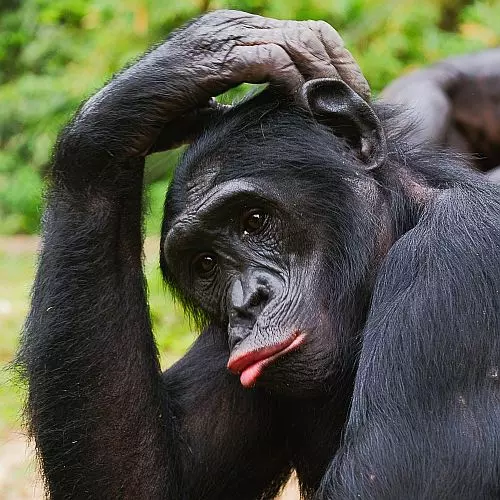
Chimpanzees are native to the tropical forests and woodlands of Central and West Africa. They are found in countries such as the Democratic Republic of the Congo, Cameroon, Gabon, Uganda, Tanzania, and Côte d'Ivoire. Although they spend much of their time in trees, they also travel long distances on the ground while searching for food.
Chimpanzees belong to the great ape family, known as Hominidae, which also includes humans, gorillas, and orangutans. Scientists recognize two species: the common chimpanzee and the bonobo. Bonobos live mainly south of the Congo River and differ from common chimpanzees in several aspects of their social behavior.
The chimpanzee has a strong and muscular body covered with black or dark brown hair. It has long arms, flexible shoulders, and hands with opposable thumbs that allow it to grasp objects firmly. Its feet are also adapted for climbing trees. Adult males usually weigh between 40 and 70 kilograms, while females are generally smalle
r.
Chimpanzees are omnivorous animals. Their diet mainly consists of fruits, leaves, flowers, seeds, nuts, and tree bark. They also eat insects, termites, honey, eggs, and occasionally small mammals. Groups of chimpanzees sometimes cooperate to hunt monkeys or small antelopes, demonstrating impressive teamwork and planning.
One of the most remarkable characteristics of the chimpanzee is its intelligence. It can solve problems, remember complex information, learn through observation, and adapt quickly to new situations. Young chimpanzees acquire many skills simply by watching and copying older members of their community, allowing knowledge to be passed from one generation to another.
Chimpanzees are among the few animals capable of making and using tools. They carefully select sticks to remove termites from their nests, use stones to crack hard nuts, fold leaves into sponges to collect drinking water, and use branches to reach food. These behaviors demonstrate planning, reasoning, and an understanding of cause and effect.
Scientific studies have shown that chimpanzees possess an extraordinary memory. Some individuals can remember the location of several numbers displayed on a screen for only a fraction of a second and recall them with remarkable accuracy, sometimes outperforming trained humans in specific memory tasks.
Communication among chimpanzees is highly sophisticated. They use a combination of vocal sounds, facial expressions, body movements, hand gestures, and physical contact to communicate with one another. These signals help them warn others of danger, organize hunting activities, strengthen social bonds, express emotions, and resolve conflicts.
Chimpanzees live in complex social communities that may include dozens of individuals. Each community has a social hierarchy led by a dominant male. Members cooperate in finding food, defending their territory, caring for young individuals, and protecting one another from predators. Grooming is an important daily activity that strengthens friendships and reduces tension within the group.
Reproduction in chimpanzees is relatively slow. The female has a pregnancy lasting about eight months and usually gives birth to a single infant. The young chimpanzee depends on its mother for several years, during which it learns how to climb, search for food, use tools, communicate, and interact with other members of the community.
Chimpanzees display a wide range of emotions similar to those of humans. They experience happiness, fear, sadness, curiosity, affection, anger, and grief. They comfort injured companions, care for orphaned young, and sometimes remain near deceased group members, suggesting deep emotional attachment.
Chimpanzees have become extremely important in scientific research because they provide valuable information about human evolution. Their anatomy, genetics, intelligence, behavior, and social organization help researchers better understand how early humans may have lived and how cognitive abilities evolved over millions of years.
Unfortunately, chimpanzees face many serious threats. Large areas of their natural habitat are being destroyed by deforestation, agriculture, mining, and urban expansion. Illegal hunting, the bushmeat trade, wildlife trafficking, and infectious diseases have also contributed to a significant decline in wild populations.
Many conservation programs have been established to protect chimpanzees. National parks and wildlife reserves preserve their habitats, while international organizations work to prevent illegal hunting, combat wildlife trafficking, educate local communities, and support scientific research. Conservation efforts are essential for ensuring the long-term survival of these remarkable animals.
Today, the chimpanzee is widely recognized as one of the world's most intelligent animals. Its exceptional memory, ability to create and use tools, advanced communication skills, emotional complexity, and cooperative social life make it one of the closest living relatives of humans and one of the most fascinating species on Earth.
Conclusion
The chimpanzee is an extraordinary primate whose intelligence, adaptability, and social behavior continue to amaze scientists around the world. Protecting chimpanzees is essential not only for conserving biodiversity but also for advancing our understanding of human evolution, animal intelligence, and the natural world. Their survival depends on continued conservation efforts, habitat protection, and global cooperation to preserve one of humanity's closest living relatives.
اترك تعليقاً
لن يتم نشر عنوان بريدك الإلكتروني. الحقول المطلوبة مشار إليها بـ *