

Snakes are legless reptiles belonging to the order Squamata. There are more than 4,000 known snake species distributed across almost every continent except Antarctica. They occupy a wide variety of habitats, including forests, deserts, grasslands, wetlands, mountains, and oceans. Snake species vary greatly in size, color, behavior, diet, and venom.
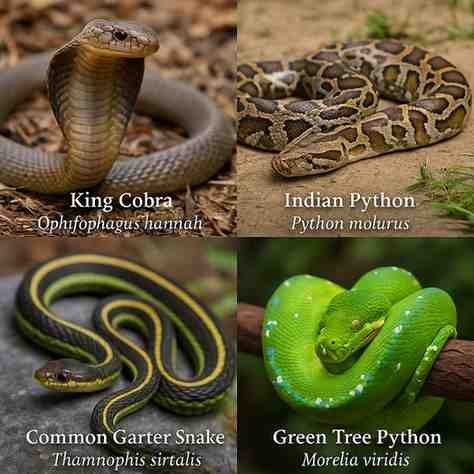
Scientists classify snakes into many different families based on their physical characteristics, behavior, and evolutionary history. Some families contain harmless species, while others include highly venomous snakes. Each family has unique adaptations that help its members survive in different environments.
One of the largest snake families is Colubridae, which contains more than half of all known snake species. Most colubrids are harmless to humans, although some possess mild venom. Examples include rat snakes, king snakes, garter snakes, and water snakes. They are found in forests, grasslands, deserts, and wetlands throughout the world.
The family Elapidae includes some of the world's most venomous snakes. Members of this family possess short, fixed front fangs that inject powerful neurotoxic venom. Well-known species include cobras, king cobras, mambas, coral snakes, kraits, and sea snakes. These snakes are found in Africa, Asia, Australia, and parts of the Americas.
The family Viperidae contains vipers and pit vipers. These snakes have long, hinged fangs that fold backward when the mouth is closed. Their venom mainly attacks body tissues and blood circulation. Famous species include rattlesnakes, puff adders, Gaboon vipers, Russell's vipers, and bushmasters. They are found in Europe, Asia, Africa, and the Americas.
The family Pythonidae includes pythons, which are among the largest snakes in the world. Pythons are non-venomous constrictors that kill prey by wrapping their muscular bodies around it and squeezing until breathing stops. Notable species include the reticulated python, Burmese python, and African rock python.
The family Boidae includes boas and anacondas. Like pythons, they are non-venomous constrictors. The green anaconda is one of the heaviest snakes on Earth, while the boa constrictor is widely distributed across Central and South America.
The family Hydrophiinae, commonly known as sea snakes, includes species that spend most or all of their lives in the ocean. They possess flattened tails for swimming and highly potent venom used to capture fish. Most sea snakes inhabit the warm waters of the Indian and Pacific Oceans.
Snake species vary greatly in size. The tiny Barbados threadsnake measures only about 10 centimeters in length, making it the smallest known snake. In contrast, the reticulated python can exceed 9 meters in length, making it the longest snake in the world. The green anaconda is considered the heaviest snake, weighing over 200 kilograms.
Snakes have evolved many methods of hunting. Venomous snakes inject toxins that immobilize or kill their prey. Constrictors suffocate their victims by coiling around them. Other species simply seize and swallow their prey alive. Depending on the species, snakes feed on rodents, birds, eggs, frogs, fish, insects, lizards, and even other snakes.
Most snake species reproduce by laying eggs, a method known as oviparity. However, some species give birth to live young, a reproductive strategy called viviparity. Female pythons are unusual because they coil around their eggs and generate heat by contracting their muscles to keep the eggs warm until they hatch.
Snakes possess remarkable sensory adaptations. They use their forked tongues to collect chemical particles from the air and transfer them to the Jacobson's organ, allowing them to detect prey, predators, and potential mates. Some pit vipers also have heat-sensitive organs that enable them to locate warm-blooded animals even in complete darkness.
Despite their reputation, most snake species are harmless to humans. Only a relatively small percentage possess venom dangerous enough to cause severe injury or death. Snakes play a crucial ecological role by controlling rodent populations, maintaining ecosystem balance, and serving as prey for larger animals.
Many snake species are threatened by habitat destruction, pollution, illegal wildlife trade, climate change, and persecution by humans. Conservation programs aim to protect snake habitats, reduce illegal collection, educate the public about their ecological importance, and preserve biodiversity.
Conclusion
Snake species are among the most diverse and adaptable reptiles on Earth. From tiny threadsnakes to giant pythons and anacondas, each species has unique adaptations that allow it to survive in different environments. Although some snakes are venomous, the majority are harmless and play an essential role in maintaining healthy ecosystems. Protecting snake species is important for conserving biodiversity and ensuring ecological balance.
Leave a comment
Your email address will not be published. Required fields are marked *